
Guide
Complete EU Code 95 Guide for Truck Drivers
Get clear, reliable information about EU Code 95 certification, renewal, training requirements, and legal compliance for professional drivers.
Our guide section is designed to help drivers, transport companies, and recruiters quickly and confidently understand the qualification process, required documents, and next steps. Whether you’re applying for the first time or renewing your Code 95, we’re here to support you at every stage.
 Check Code 95 Eligibility
  Understand Code 95 (CPC)
  Training & Renewal Requirements
  Tachograph & Driving Compliance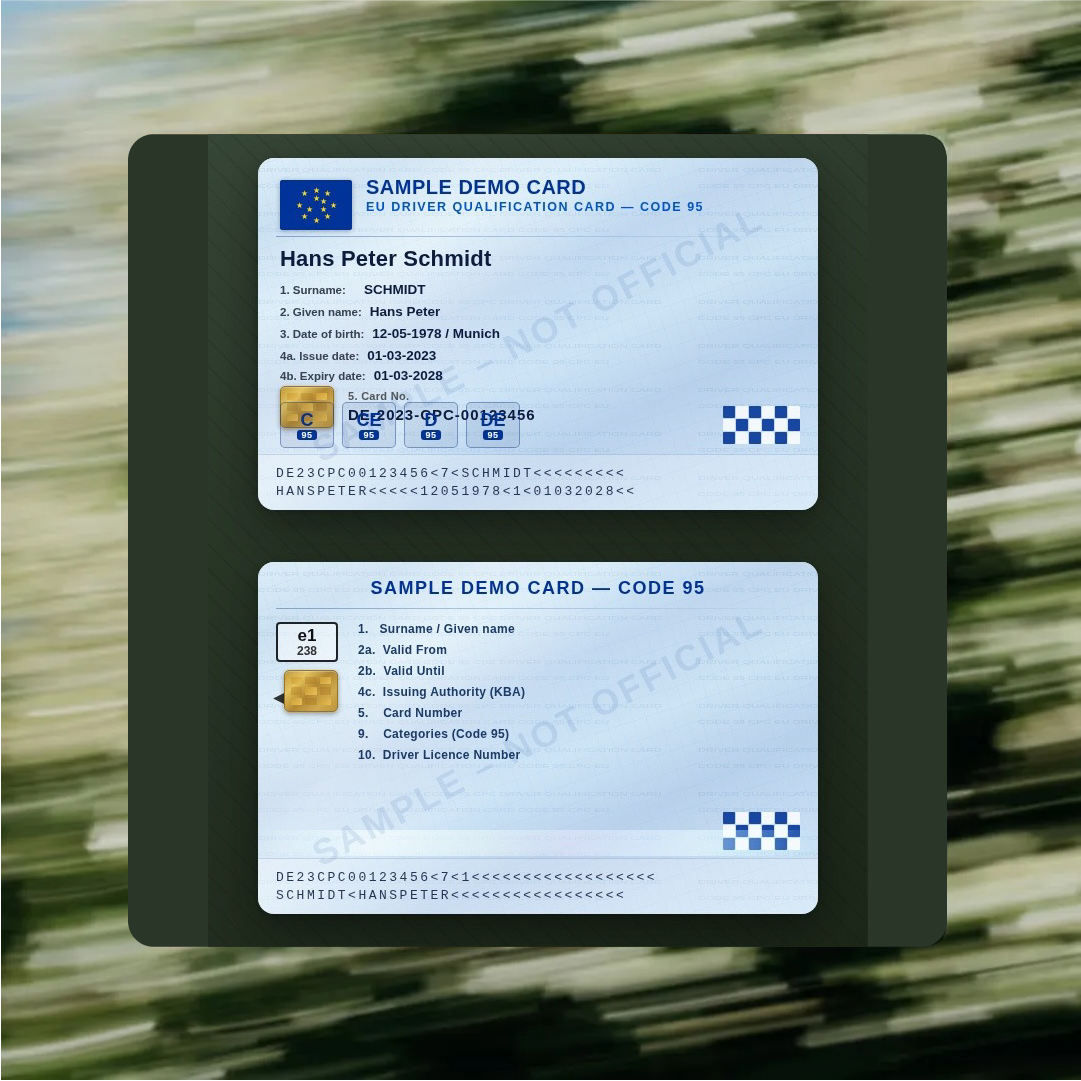
Introduction
For every professional truck and bus driver working across Europe, two things must always travel together: the right driving licence and a valid Code 95. The licence proves you can operate the vehicle. Code 95 proves you are professionally qualified to do so commercially. Without both, no driver can legally carry goods or passengers for hire and reward anywhere in the European Union.
This complete EU Code 95 guide explains exactly what Code 95 is, who needs it, how to get it, how to keep it current, and what happens if it lapses. Written for professional drivers, recruiters, transport companies, and non-EU drivers looking to build a career in European road transport, it brings together the EU rules and the practical steps you need to stay compliant and employable across all 27 member states.
If you are an employer looking to recruit qualified drivers, you can Hire Professional Truck Drivers through FastDriver. Drivers ready to work across Europe can complete Truck Driver Registration Europe to access opportunities directly.
What Is Code 95?
Code 95 is the professional driver qualification that every commercial truck and bus driver in the European Union must hold alongside their driving licence. Established under EU Directive 2003/59/EC and enforced across all 27 EU member states and the EEA countries, it confirms that a driver has completed the minimum professional training and competence standards required by EU law to operate heavy goods and passenger-carrying vehicles commercially.
The number "95" refers to the harmonised code printed in column 12 of the EU driving licence next to the relevant vehicle category — for example, "C 95" or "CE 95" — or shown on a separate Driver Qualification Card (DQC) issued by the national authority. This is the credential that enforcement officers, employers, and border authorities check to confirm a driver is professionally qualified.
Crucially, Code 95 is not a licence category. It is a separate professional qualification that runs in parallel with the licence. A driver can hold a Category CE licence and still be unable to drive commercially if their Code 95 is missing or expired. Both must be valid simultaneously for every commercial journey. To confirm your standing, you can check Code 95 Eligibility.
Why Code 95 Is Mandatory in Europe
Code 95 is mandatory because driving a heavy commercial vehicle safely and professionally demands far more skill than a standard driving test measures. A driving licence shows the mechanical ability to control a vehicle. Code 95 shows professional competence — understanding driving-hours rules, managing fatigue, driving efficiently, securing loads, and operating safely over long shifts and in demanding conditions.
Before EU Directive 2003/59/EC, professional driver training varied widely across countries, leading to uneven safety standards and unfair competition. Code 95 set a single EU-wide minimum, ensuring every professional driver on European roads — whatever their nationality or country of employment — meets the same baseline competence.
Enforcement is active and immediate. A driver who cannot produce a valid Code 95 at a roadside inspection is stopped from continuing the commercial journey on the spot. Operators who deploy unqualified drivers face fines, licence action, and civil liability. The system is built so non-compliance carries real, immediate consequences.
Difference Between Driving Licence and Code 95
The distinction is simple but essential: the driving licence permits driving; Code 95 permits driving for hire and reward. The national driving licence authority issues the licence and typically remains valid for years, subject to periodic medical checks. The national transport or licensing body issues code 95, which is valid for only five years, and must be renewed through 35 hours of periodic training.
Both are legally independent and separately enforced. One can never substitute for the other — a valid licence does not cover a lapsed Code 95, and a valid Code 95 is meaningless without the corresponding licence category. To verify your licence category status, you can check EU Driving Licence Eligibility.
Which Drivers Need Code 95?
Code 95 is required for any professional driver operating commercially in the EU, the EEA, or any country that recognises the EU Driver CPC framework. The obligation is triggered by the commercial nature of the activity and the vehicle category — not by the driver's nationality or experience.
Drivers who must hold Code 95 include:
- Drivers operating Category C, C1, CE, or C1E goods vehicles commercially
- Drivers operating Category D, D1, DE, or D1E passenger vehicles commercially
- Employed professional drivers working for hauliers, logistics firms, or passenger transport operators
- Self-employed drivers carrying out commercial transport for reward
- Third-country nationals legally employed as drivers in EU member states
- Non-EU drivers conducting commercial transport on EU roads
Drivers Exempt from Code 95
A limited set of drivers and uses is exempt from Code 95 under EU law:
- Drivers of vehicles with a maximum design speed not exceeding 45 km/h
- Military and police drivers operating on official duties
- Drivers carrying out technical development, repair, or maintenance test runs
- Drivers using large vehicles non-commercially for personal or agricultural purposes
- Driving instructors operating at authorised driving schools
- Drivers of vehicles used exclusively for humanitarian aid operations
These exemptions are narrow. Any driver uncertain whether an exemption applies should confirm with their national authority before driving without Code 95.
Vehicle Categories Requiring Code 95
Code 95 applies to the commercial use of specific EU driving licence categories. The requirement depends on the vehicle category and the commercial nature of the journey.
| Licence Category | Vehicle Type | Code 95 Required? |
|---|---|---|
| C | Rigid goods vehicles over 3,500 kg | Yes — commercial use |
| C1 | Goods vehicles 3,500–7,500 kg | Yes — commercial use |
| CE | Articulated HGV or truck and trailer | Yes — mandatory |
| C1E | C1 vehicle with trailer over 750 kg | Yes — commercial use |
| D | Buses carrying more than 8 passengers | Yes — mandatory |
| D1 | Minibuses (9–16 passenger seats) | Yes — commercial use |
| DE | Bus with trailer | Yes — mandatory |
| D1E | Minibus with trailer | Yes — commercial use |
Difference Between CE Licence and Code 95
The CE licence and Code 95 are two distinct, separately enforced requirements that must both be valid at the same time for lawful commercial driving. Understanding this is one of the most important compliance fundamentals for any driver or operator in Europe.
| Feature | CE Driving Licence | Code 95 |
|---|---|---|
| What it confirms | Legal authorisation to drive the vehicle | Professional competence and training compliance |
| Issued by | National driving licence authority | National transport or licensing body |
| Validity | Years, with periodic medical renewals | 5 years, renewed by 35 hours of training |
| Renewal requirement | Medical fitness assessment | 35 hours of approved periodic training |
| Required for commercial driving | Yes — always | Yes — always |
| Can substitute the other | No | No |
EU Laws Governing Code 95
Code 95 sits within a framework of EU legislation that defines the qualifications, training, and related compliance rules that every professional driver must follow.
EU Directive 2003/59/EC
The primary legal basis for Code 95. It establishes the initial qualification and periodic training framework for professional drivers across all EU member states, setting minimum training hours, subject areas, and mutual recognition arrangements.
EU Directive 2018/645
This directive amended 2003/59/EC to allow more online and blended learning, introduced training content on electric and alternative-fuel vehicles, and updated eco-driving requirements — modernising the qualification for current transport realities.
Regulation (EC) No 561/2006
Establishes the EU driving hours rules that every Code 95 driver must understand and apply. Knowledge of these rules is part of the professional competence the qualification certifies.
Regulation (EU) No 165/2014
Governs the tachograph and its correct use, which forms a core part of the Code 95 competence framework. To verify your compliance, you can check Tachograph Eligibility.
National Implementing Legislation
Each EU member state transposes Directive 2003/59/EC into its own national law, with its own enforcement powers, penalty structures, and procedures for issuing the Driver Qualification Card.
Initial Qualification vs Periodic Training
The Code 95 framework runs in two stages: initial qualification for drivers entering the profession and periodic training to maintain their qualification every 5 years.
Standard Route — 280 Hours
The standard initial qualification route suits drivers entering the profession and is often combined with obtaining the licence itself.
- Minimum 280-hour approved training programme
- Minimum 20 hours of individual driving at the wheel
- Written and practical theory examinations
- Practical driving test required
Accelerated Route — 140 Hours
The accelerated route is available to drivers who already hold the relevant licence category and want a faster entry into commercial driving.
- Minimum 140-hour approved training programme
- Minimum 10 hours of individual driving at the wheel
- Same examinations as the standard route
35-Hour Periodic Training
Periodic training keeps an existing qualification up to date. It applies to every qualified driver, every five years.
- 35 hours of approved training, in modules of at least 7 hours each
- No examination — continuing professional development only
- Must be completed at an approved training centre
- Can be spread across the five-year validity period in any order
How to Get Code 95 in Europe
Obtaining Code 95 follows a clear sequence, though specific procedures vary by member state.
Step 1 — Hold the Right Licence Category
You must first hold a valid EU driving licence in the relevant category. For goods vehicles, that means Category C or CE. For passenger vehicles, Category D or D1. The licence is a prerequisite — Code 95 cannot be issued without it, although both can be pursued together through an integrated programme.
Step 2 — Enrol with an Approved Training Centre
Code 95 training must be completed with a provider officially approved and registered by the national authority in your country of residence or employment. Always confirm a centre holds current approval for your specific vehicle category before paying or enrolling.
Step 3 — Complete the Required Training Hours
Complete 280 hours (standard route, including 20 hours driving) or 140 hours (accelerated route, including 10 hours driving). Training covers both theory and practical skills across all subject areas in Annex I of EU Directive 2003/59/EC.
Step 4 — Pass the Professional Competence Tests
Initial qualification requires written and practical theory examinations administered by the national authority or an authorised body, testing road safety, vehicle operation, transport law, driving hours, and load security. Some member states also require a practical driving test.
Step 5 — Receive Your Code 95 Endorsement
Once you pass, the national authority records the qualification. In most countries, this means "95" is printed in column 12 of your licence next to the category, and a Driver Qualification Card is issued showing the validity period. The DQC must be carried while driving commercially and produced on demand at inspections.
Required Documents
While documentation varies by member state, applicants typically need:
- Valid EU driving licence in the relevant category
- Proof of identity (passport or national ID)
- Proof of legal residence in the member state
- Passport-style biometric photographs
- Completed the application form from the national authority
- Evidence of completed approved training
- Applicable fee payment
Approved Training Centres
Code 95 training is only valid when delivered by a provider formally approved and registered by the national authority. Approved centres appear on public national registers. Training completed at an unapproved centre does not count toward the qualification or renewal — regardless of content quality — so verifying approval status before enrolling is essential.
Code 95 Training Topics
All Code 95 training, whether initial or periodic, must cover the subject areas in Annex I of EU Directive 2003/59/EC, including:
- Advanced and safe driving, including vehicle dynamics, braking distances, and load distribution
- Fuel-efficient eco-driving and environmental best practice
- Health and safety, EU driving hours rules, tachograph use, and fatigue management
- Road safety awareness, accident prevention, and emergency response
- Customer service and the professional image of the transport industry
- Updates to the EU and national transport law for the driver's category
- Electric, hybrid, and alternative-fuel vehicle operation (added under the 2018 amendment)
Code 95 Validity & Renewal Rules
Code 95 is valid for 5 years from the date of initial qualification or the most recent periodic training renewal recorded on the Driver Qualification Card. The five years are fixed and cannot be extended — it is maintained only through timely, periodic training.
Drivers must complete all 35 hours of periodic training before the expiry date on their DQC. There is no late renewal, no retrospective completion, and no grace period. The 35 hours can be taken in modules of at least 7 hours each, at any time and in any order across the five years. Under the 2018 amendment, some member states permit part of the training to be delivered online or in blended formats — confirm availability with your national authority first.
Drivers are strongly advised to begin booking periodic training at least twelve months before expiry, as course places can be limited close to deadlines.
What Happens If Code 95 Expires?
If Code 95 expires without the required 35 hours completed and recorded, the driver immediately loses the legal right to drive commercially in any regulated category. The expiry is effective from the date on the Driver Qualification Card, with no grace period.
To reinstate an expired Code 95, the driver must complete the full 35-hour periodic training programme again — regardless of any hours done before expiry — and apply for a new DQC. Driving commercially with an expired Code 95, even once, is a regulatory violation and carries the full range of enforcement consequences for both the driver and the operator.
Working as a Truck Driver in Europe
A valid Code 95 with the right licence category opens the door to the full European road transport jobs market — one of the continent's largest employment sectors. Demand for qualified drivers, especially Category CE holders with current Code 95, consistently exceeds supply across many member states.
Opportunities span general haulage and logistics, refrigerated transport, tanker and hazardous goods carriage, construction and aggregate delivery, automotive and specialist freight, retail distribution, and international cross-border operations. To see what's available now, you can browse Truck Driver Vacancies in Europe.
EU Truck Driver Salary Insights
Professional driver salaries vary considerably by country, licence category, specialisation, and experience. Category CE drivers with current Code 95 consistently earn more than those holding only Category C or lacking a current qualification. Specialist endorsements, such as ADR for hazardous goods or temperature-controlled transport, attract additional premiums.
Western and northern EU countries generally offer higher nominal salaries than central and eastern member states, though cost-of-living differences narrow the real-terms gap considerably. Drivers researching a specific country should consult national transport employer associations or official statistical sources for accurate, current figures.
International Driving Opportunities
Code 95-qualified drivers with EU licences enjoy unmatched professional mobility. A Category CE licence with current Code 95, issued by any EU member state, authorises commercial driving in all 27 EU countries and the EEA states, with no licence conversion, re-examination, or extra national qualification required.
International roles typically involve cross-border freight between member states, long-distance point-to-point delivery across multiple countries, and cabotage operations within the applicable EU limits on domestic transport by non-resident carriers.
Driving Hours & Tachograph Rules
Every Code 95 driver operating Category C, CE, D, or related vehicles commercially must comply with the EU driving hours rules under Regulation (EC) No 561/2006 and the tachograph rules under Regulation (EU) No 165/2014. Applying these rules correctly is itself part of Code 95 professional competence, including awareness of the latest smart tachograph requirements under the EU Mobility Package.
Key driving hours requirements:
- Maximum 9 hours driving per day, extendable to 10 hours twice per week
- Maximum 56 hours driving per calendar week
- Maximum 90 hours driving over any two consecutive weeks
- Mandatory 45-minute break after 4.5 hours of driving
- Minimum 11-hour daily rest period
- Minimum 45-hour regular weekly rest period
Code 95 for Non-EU Drivers
Third-country nationals legally resident or employed as drivers in an EU member state can obtain Code 95 through the standard qualification process in their country of residence. Nationality does not change the requirement or the process. Non-EU drivers whose home country is outside the EU Driver CPC framework must complete the full initial qualification through an approved EU training provider. There is no shortened pathway based on home-country experience, unless a specific bilateral recognition agreement applies.
Non-EU drivers should begin by securing the right to work and a recognised EU licence, then pursue Code 95. To register your interest in EU driving roles, complete Truck Driver Registration Europe.
Licence Conversion Rules
Non-EU drivers must first hold or convert to a valid EU driving licence for the relevant category. Where a bilateral exchange agreement exists between the EU member state of residence and the driver's home country, the foreign licence may be exchangeable for an EU equivalent. Where no agreement exists, the driver must complete the full EU licence acquisition process, including theory and practical tests.
Importantly, holding a converted EU licence does not automatically grant Code 95 — the professional qualification must be obtained separately through the initial qualification process at an approved centre.
Work Permit Considerations
Non-EU nationals seeking work as professional drivers in the EU must hold immigration status that legally permits employment in that country. Visa categories, work permit types, and eligibility vary by member state, nationality, and bilateral agreements. Drivers and employers should confirm current immigration and work authorisation requirements with the relevant national authority before employment begins. Driving commercially without a valid work authorisation is a serious offence with consequences for both the driver and the operator, separate from any licence or Code 95 requirements.
Countries Hiring Code 95 Drivers
Qualified Code 95 drivers with EU licences are in strong demand across all 27 member states, with particularly high demand reported in Germany, the Netherlands, France, Poland, Belgium, Austria, Sweden, and Denmark. The structural driver shortage across the EU transport sector is a well-documented reality, creating consistent opportunities for qualified drivers throughout the industry. Employers seeking to fill these roles can Hire Professional Truck Drivers through FastDriver's verified network.
Common Code 95 Mistakes
Driving Without a Valid Code 95
The most serious mistake is driving commercially without Code 95 or after it has expired. Both lead to immediate prohibition at inspection, fines, and an entry in the compliance record. A driving licence alone is never enough — both the licence and Code 95 must be current simultaneously.
Missing Periodic Training Deadlines
Many drivers let Code 95 lapse simply through poor planning — not tracking the expiry date or leaving all 35 hours until the last weeks when course places run short. There is no grace period, no partial credit, and no retrospective renewal without redoing the full programme.
Using Non-Approved Training Centres
Training at a provider not approved by the national authority is invalid. Those hours do not count toward qualification or renewal, whatever the content. Always verify approval status before enrolling, and confirm with the national authority if unsure.
Ignoring Tachograph and Compliance Rules
Code 95 competence includes correctly applying the tachograph and driving hours rules — these are not separate from the qualification. Holding Code 95 while routinely breaching these rules defeats the purpose of the qualification and poses direct safety risks and regulatory penalties.
Benefits of Holding Code 95
Legal Eligibility to Work
Code 95 is the non-negotiable foundation of legal commercial driving across the EU and EEA. Without it, no commercial driving in regulated categories is lawful. For anyone building a career in European road transport, it is the base on which every other opportunity depends.
Higher Salary Opportunities
Drivers who keep Code 95 current — especially alongside specialist qualifications like ADR or temperature-controlled transport — consistently access higher salary bands. Employers value demonstrably compliant, qualified drivers and reflect this in pay, particularly for international and specialist roles.
Access to International Transport Jobs
A current Code 95 with a Category CE licence is the standard minimum for international driving roles across the EU. It provides immediate access to cross-border haulage, international logistics, and multinational operators seeking drivers who can work legally across member states.
Improved Safety and Professional Skills
Periodic training is genuine professional development, keeping drivers current on best practice in vehicle operation, road safety, fuel efficiency, and compliance. Drivers who engage fully improve their safety record, cut operating costs through efficient driving, and strengthen their professional reputation.
EU Code 95 Certification – Requirements & Renewal Guide
Understand the official EU Code 95 (CPC) requirements for professional truck and bus drivers. Learn about eligibility, required documents, 35-hour periodic training, renewal rules, and compliance before working in Europe.
 Albania
 Andorra
 Austria
 Belarus
 Belgium
 Bosnia and Herzegovina
 Bulgaria
 Croatia
 Cyprus
 Czech Republic
 Denmark
 Estonia
 Finland
 France
 Germany
 Greece
 Hungary
 Iceland
 Ireland
 Italy
Italy
 Latvia
 Liechtenstein
 Lithuania
 Luxembourg
 Malta
Malta
 Moldova
 Monaco
 Montenegro
 Netherlands
 North Macedonia
 Norway
 Poland
 Portugal
 Romania
 Russia
 San Marino
 Serbia
 Slovakia
 Slovenia
 Spain
Spain
 Sweden
 Switzerland
 Ukraine
 United Kingdom
 Vatican City
Which Drivers Are Required to Hold Code 95 in Europe?
Code 95 is mandatory for all professional drivers operating Category C, C1, CE, D, or D1 vehicles commercially in the EU and EEA. The requirement depends on the commercial nature of the work and the vehicle category — not on the driver's nationality or experience. It applies to EU and non-EU drivers alike.- What is Code 95, and why is it required for professional truck drivers working in Europe?
- Is Code 95 mandatory for professional truck drivers working in the European Union?
- Who is legally required to hold a valid Code 95 qualification when driving professionally in Europe?
- How long is a Code 95 qualification valid for professional drivers in Europe?
- How can professional truck drivers renew their Code 95 qualification in Europe?
- How many hours of training are required to renew Code 95 in Europe?
- Can foreign truck drivers obtain Code 95 and work professionally in Europe?
- Is Code 95 recognised across all European Union countries?
- Does having Code 95 improve job opportunities for truck drivers in Europe?
- Can professional truck drivers legally work in Europe without Code 95?
- Which driving licence categories usually require Code 95 for professional work in Europe?
- What is the difference between Code 95 and Driver CPC in Europe?
- Can a driver obtain Code 95 without completing professional training?
- Is Code 95 required for both truck and bus drivers in Europe?
- Can non-EU citizens apply for Code 95 training in Europe?
- What documents are usually required to apply for Code 95 training?
- Can employers sponsor Code 95 training for foreign truck drivers?
- How long does it usually take to obtain Code 95 in Europe?
- Can drivers complete Code 95 training in English in some European countries?
- Is Code 95 required for local delivery drivers working commercially in Europe?
- Is Code 95 required for long-haul international truck drivers in Europe?
- Can drivers transfer Code 95 from one EU country to another?
- Does Code 95 expire automatically after five years?
- What happens if Code 95 expires while working as a truck driver in Europe?
- Can a driver renew Code 95 before it expires?
- Do European transport companies check whether Code 95 is valid before hiring drivers?
- Can Code 95 help foreign drivers access more European job opportunities?
- Is periodic Code 95 training focused on road safety and professional driving standards?
- Can Code 95 training be completed online in some European countries?
- Is Code 95 linked to road safety regulations in Europe?
- Can professional truck drivers lose Code 95 due to serious violations?
- Do newly qualified truck drivers need Code 95 before starting professional work in Europe?
- Can drivers work for multiple transport companies using the same Code 95 qualification?
- Is Code 95 required for self-employed truck drivers in Europe?
- Can Code 95 increase salary potential for truck drivers in Europe?
- Do logistics companies prefer drivers who already have Code 95?
- Can Code 95 be combined with Category C+E to access the best truck driving opportunities in Europe?
- Is Code 95 required for cross-border transport between European countries?
- Can drivers start Code 95 training immediately after obtaining a truck licence?
- Does Code 95 help employers meet legal compliance requirements?
- Can Code 95 qualifications be checked during roadside inspections in Europe?
- Are penalties possible for driving professionally without a valid Code 95 qualification?
- Can employers face penalties for hiring drivers without valid Code 95 qualifications?
- Is Code 95 one of the most important qualifications for professional truck drivers in Europe?
- Can Code 95 improve career progression in the European transport industry?
- Do most European truck driving job advertisements mention Code 95 as a requirement?
- Can drivers renew Code 95 multiple times throughout their career?
- Is Code 95 recognised by transport companies across Europe?
- What is the best qualification combination for building a successful truck driving career in Europe?
- Need Help With Your European Truck Driving Career?
- Need More Information About Code 95?
Final Thoughts
Code 95 is the professional backbone of commercial driving across Europe. For drivers, it is the qualification that turns a driving licence into a livelihood, opening access to one of the EU's largest and most in-demand employment sectors. For employers, it is the proof of professional competence that protects safety, compliance, and the operator's licence.
The keys to staying compliant are simple: hold the right licence category, keep Code 95 current through timely periodic training, train only with approved centres, and apply the driving hours and tachograph rules on which the qualification is built. With the EU facing a sustained driver shortage, qualified Code 95 drivers have never been more valuable or more mobile across the continent.
To recruit qualified, compliant drivers, employers can Hire Professional Truck Drivers through FastDriver. Drivers can register for opportunities or Browse Truck Driver Vacancies in Europe to take the next step in their career.
Disclaimer
This guide is provided for general informational purposes only and does not constitute legal, regulatory, or professional advice. Code 95 rules, training requirements, fees, and enforcement procedures are subject to legislative updates and vary in implementation across EU member states. Readers should verify the current requirements applicable to their situation with the relevant national authority, the European Commission's official transport resources, or a qualified transport compliance professional before making any operational, legal, or career decisions. FastDriver makes reasonable efforts to maintain accurate information but accepts no liability for any errors, omissions, or actions taken in reliance on this guide.
Official EU References
- European Commission — Mobility and Transport — https://transport.ec.europa.eu
- EU Directive 2003/59/EC (EUR-Lex) — https://eur-lex.europa.eu
- EU Directive 2018/645 (EUR-Lex) — https://eur-lex.europa.eu
- Regulation (EC) No 561/2006 (EUR-Lex) — https://eur-lex.europa.eu
- Regulation (EU) No 165/2014 (EUR-Lex) — https://eur-lex.europa.eu
- European Labour Authority (ELA) — https://www.ela.europa.eu
About FastDriver.eu
FastDriver.eu is Europe's trusted platform for professional truck driver recruitment and transport compliance information. We connect verified professional drivers with reputable transport operators across all 27 EU member states, offering clear, practical guidance on EU driving licences, Code 95 qualification, tachograph compliance, and driver welfare. For employers, we deliver pre-vetted candidates ready to work. For drivers, we provide access to opportunities across Europe and straightforward guidance on every aspect of EU transport regulation.

Ready to get your Code 95 in Europe?
We help you qualify, train, and stay compliant, anywhere in Europe.
Show all Code 95 courses
Last Updated: January 30, 2026
This content is reviewed and updated periodically to maintain accuracy and relevance.
Why FastDriver.eu ?
Our mission is to simplify truck driver recruitment across Europe.

Expanding Access
We continuously expand access to qualified, verified EU and non-EU truck drivers across Europe. By adapting to evolving transport demands and regulatory frameworks, we enable employers to secure talent efficiently and at scale.

Streamlining Recruitment
FastDriver.eu removes complexity from the hiring process by simplifying job posting, candidate shortlisting, and coordination. Our structured workflows reduce administrative effort, accelerate hiring timelines, and support informed decision-making.

People-Centered Approach
We place employers and drivers at the core of our platform. By combining industry expertise with a responsible, transparent approach, we deliver trust, reliability, and peace of mind throughout the recruitment journey.
FastDriver.eu is where truck drivers get hired:
Our job portal connects logistics companies with verified truck drivers across Europe and beyond.
5K+
Driver-job matches completed
43+
Countries and territories
200+
Hiring companies

5K+
Driver-job matches completed
43+
Countries and territories
200+
Hiring companies
Get Started with FastDriver
Our Platform
We connect truck drivers, transport companies, and recruiters across Europe through a dedicated driver job platform.

Employer
Register as a company to post truck driver jobs, manage vacancies, and connect directly with qualified professional drivers.

Drivers
Register as a driver to explore truck and commercial driving jobs across Europe and apply directly to verified employers.

Recruiters
Register as a recruiter to post driver jobs, reach active professional drivers, and support employers with fast and efficient hiring.

Trusted by Employers Across Europe

Successful hiring satisfaction

Of drivers and employers receive active support via FastDriver.eu

10+
Do you have any questions?
We support truck drivers, transport companies, and recruiters with job opportunities and driver recruitment across Europe, helping drivers find work and employers hire qualified professionals. Our job portal, FastDriver.eu, allows companies and recruiters to post driver jobs and connect directly with professional truck drivers through a simple, efficient platform.

